What Makes Kashmiri Walnuts Different?
Walnuts don't get talked about the way almonds do. Most people buy whatever's on the shelf and never think about where it came from.
That's a mistake, because walnuts vary more than almost any other dry fruit.
Kashmir has been growing walnuts for centuries, largely on trees that were never commercially planted — they grow wild across the valley, in Anantnag, Kupwara, Baramulla and Shopian. The harvest happens in September and October, and it's entirely manual.
The kernels that come out are lighter in colour than most imported walnuts, and the taste is less bitter. Bitterness in walnuts usually comes from the skin, and it gets worse as the kernel ages or oxidises. Fresh, well-stored Kashmiri kernels are noticeably milder.
The trade-off is that supply is limited and inconsistent. A bad season means less stock, and there's no way around it. That's the honest reason Kashmiri walnuts cost more than imported ones.
Kashmiri vs Chile vs California Walnuts
Three types dominate the Indian market. Here's how they compare.
| Feature | Kashmiri | Chile | California |
|---|
| Origin | Kashmir valley | Chile | USA |
|---|
| Kernel colour | Light amber | Very light, uniform | Light to medium |
|---|
| Taste | Mild, less bitter | Mild | Slightly stronger |
|---|
| Size | Medium, varies | Large, uniform | Large |
|---|
| Availability | Seasonal, limited | Year-round | Year-round |
|---|
| Typical price/kg | Highest | Mid | Low |
|---|
Which One Should You Buy?
If the walnuts are being used in cakes or recipes with strong flavours, imported varieties can work well and usually cost less. Kashmiri walnuts make more sense when you’re eating them plain or using them in dishes where their flavour remains noticeable.
Kashmiri walnuts are mostly eaten plain, a few kernels in the morning, or in a salad where the walnut is actually the flavour. That's where the milder taste shows up.
How to Spot Good Quality Akhrot
Walnuts go bad quietly. They don't grow mould or change texture much — the oil inside just turns, and by the time you taste it, the whole pack is affected. Four things worth checking:
Check the Colour
Fresh kernels are light amber. As walnuts age, they darken, and very dark kernels usually mean old stock. Some darkening is natural and varies by batch, but if most of the pack looks brown rather than amber, it's been sitting somewhere too long.
Smell Before You Buy
This is the most reliable test. Fresh walnuts smell faintly sweet, almost like nothing. Rancid walnuts have a sharp, paint-like smell that's hard to miss once you know it. If a pack smells off, don't argue with yourself about it.
Look at the Shape
Kashmiri kernels aren't perfectly uniform, the halves vary in size because the trees aren't commercially bred for consistency. Some broken pieces in a pack are normal. What you don't want is a pack that's mostly small fragments, which usually means it's been handled badly or is leftover from grading.
Compare the Price
Kashmiri walnuts sit at a premium over imported stock, though the gap depends on grade and whether you're buying kernels or in-shell. What should make you suspicious is a price well below the imported rate — at that point the economics simply don't work.
These checks aren't foolproof individually, and natural variation between batches is real. Together, though, they'll catch most problems.
How to Eat Kashmiri Walnuts
Walnuts work well when served chopped into salads, mixed into yoghurt, or added to porridge. Lightly toasting them in a dry pan for a minute brings out more flavour, though it also shortens how long they'll keep afterwards.
Should You Soak Them?
Soaking for a few hours softens the kernel and removes some of the skin's bitterness. If you find walnuts slightly bitter, try it. If you don't, skip it.
How many a day? That depends on your diet and health, and we're not going to put a number on it. Ask a doctor or dietitian if you want advice that actually applies to you.
How to Store Walnut Kernels
Walnuts have one of the highest oil contents of any nut, which is exactly why they go rancid faster than almonds or cashews.
- Airtight container, always — not the open jar on the counter
- Refrigerate once the pack is opened, especially between April and September
- The freezer works too, and doesn't affect taste
- Keep them away from onions, garlic and spices, because walnuts absorb smells
If they smell sharp or taste bitter in a way they didn't before, the oil has turned. Throw them out — rancid oil isn't worth eating.
Why Buy Kashmiri Walnuts From Waadi Nut
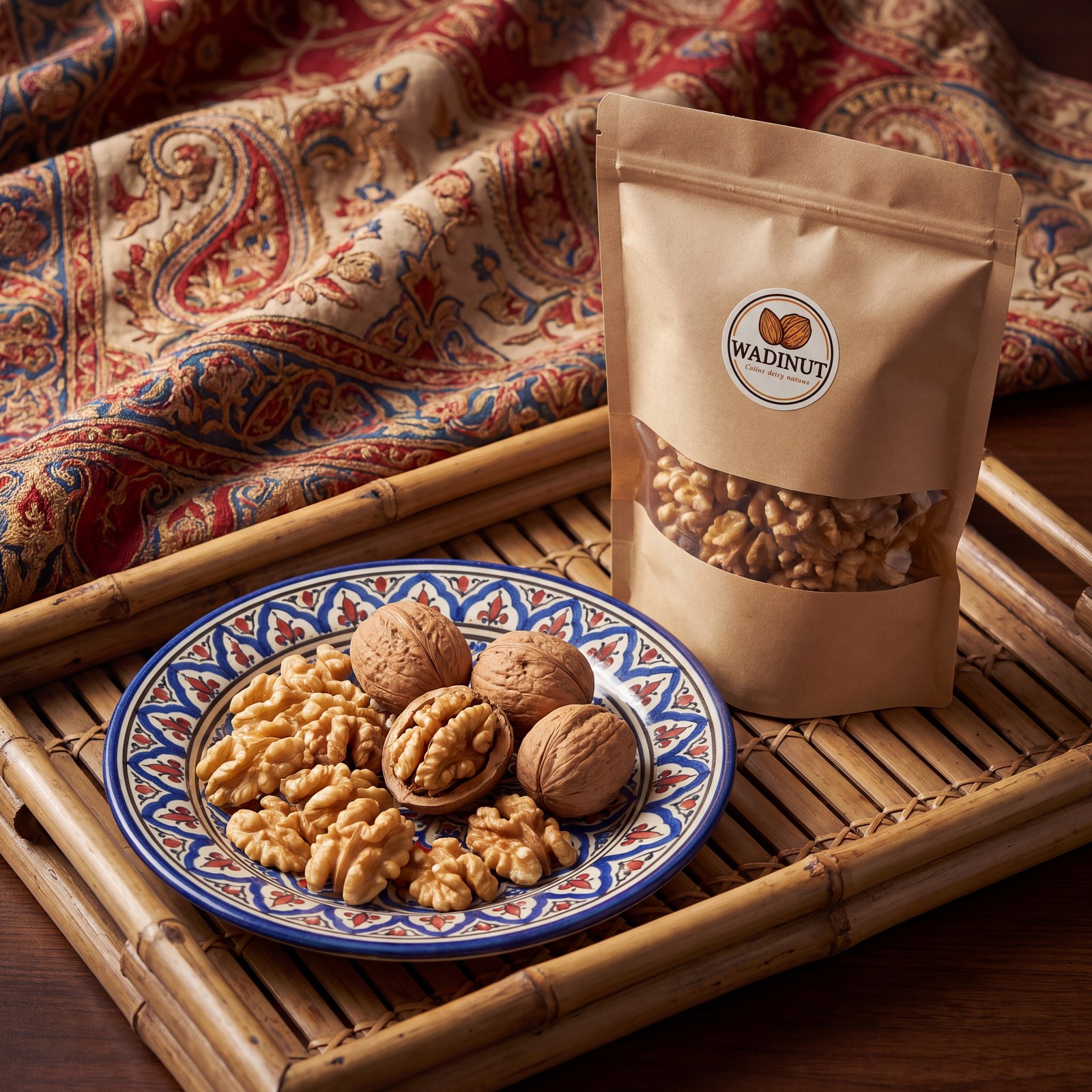
Sourced from the valley, not repacked. Our walnuts come from growers in the Kashmir valley, not from a wholesale market where origin gets blurred.
Hand-sorted. Every batch is checked before packing. Dark, shrivelled and heavily broken kernels get removed. It's slow work, but walnut quality varies enough within a single batch that machine sorting doesn't catch what matters.
No bleaching. Some walnut kernels are processed to achieve a more uniform appearance. We don’t bleach ours. Natural differences in colour are expected from one batch to another.
Vacuum-sealed. With this much oil, air exposure is the main enemy. Ordinary poly packaging doesn't do the job.

Reviews
There are no reviews yet.