What to Know Before Buying Cashews
Cashews are the one dry fruit where almost nobody knows what they're buying.
With almonds you can tell varieties apart by looking. With walnuts, colour tells you about freshness. Cashews all look more or less the same - pale, curved, uniform. The differences are in size and breakage, and both are hidden behind a grading system that most sellers never explain.
That grading system is why the same-looking pack can cost hundreds per kg.
Cashews in India come mainly from Goa, Kerala, Mangalore and Andhra Pradesh, with a large volume also imported from West Africa and Vietnam for processing. Unlike almonds or walnuts, origin matters less here than grade and handling.
What actually affects what you get is how the kernels are graded, how carefully they're sorted, and how they've been stored. Let’s understand it all here.
Cashew Grades Explained: W180, W240, W320
The "W" stands for white whole. The number is how many kernels make up one pound, so a lower number means bigger cashews.
| Grade | Kernels per pound | Size | Common use | Relative price |
|---|
| W180 | About 180 | Largest | Gifting, premium retail | Highest |
|---|
| W240 | About 240 | Large | Table use, gifting | High |
|---|
| W320 | About 320 | Medium | Everyday use, cooking | Mid |
|---|
| W450 | About 450 | Small | Bulk, commercial | Lower |
|---|
| Pieces | - | Broken | Cooking, sweets, gravies | Lowest |
|---|
Which Grade Should You Buy?
If cashews are going into a gravy, a sweet, or anything where they'll be ground or chopped, pieces make more sense than whole. They cost significantly less and the end result is identical. Buying W240 to grind into a paste is money spent on appearance nobody will see.
Whole cashews are worth it when they're being eaten as they are, or given as a gift, where size and unbroken kernels actually register.
How to Check Cashew Quality
Cashews hide their age well. They don't shrivel or change colour dramatically, so a pack that's been sitting for months can look fine. Four things to check:
Look at the Colour
Good cashews are creamy white to very pale ivory. A yellowish or greyish tint usually means age or poor storage. Very stark white kernels across an entire pack can indicate over-processing — natural cashews have slight variation.
Check for Breakage
Some breakage is unavoidable; cashews are fragile and shipping does damage. But if a pack labelled as whole has more than a handful of broken pieces, it's been graded loosely. Whole and pieces have different prices, and mixing them is a common way to cut costs.
Smell the Pack
Cashews have a high fat content and go rancid like any nut. Fresh cashews smell mild and slightly sweet. A sharp soapy like smell means the oil has oxidised. This is the fastest check and the most reliable.
Compare the Price
If a seller doesn’t mention the grade, it becomes difficult to compare the size and price fairly. Always check whether you’re buying W240, W320 or another grade.
None of these tells you everything on its own, and batches vary. Together they'll catch most of what's worth catching.
How to Use Cashews
Plain, straight from the pack, is how most cashews get eaten and there's nothing wrong with that.
Beyond that, they hold up well in cooking in a way most nuts don't. Soaked and ground, they thicken gravies without changing the flavour much, which is why so much North Indian cooking relies on them. They're also used in sweets, biryanis and pulaos, usually lightly fried first.
For salads and desserts, chopping them coarse works better than fine; cashews are soft enough that fine chopping turns them to paste.
Roasting Cashews at Home
A dry pan on low heat, stirred constantly, for three to four minutes. They go from pale to golden fast and burn faster than that, so don't walk away.
No oil needed, cashews have enough fat of their own. A pinch of salt at the end while they're still warm works better than salting before.
Roasted cashews don't keep as long as raw ones, so roast small quantities.
How many a day? That depends on your diet and health, and we're not going to put a number on it. Ask a doctor or dietitian if you want a figure that applies to you.
How to Store Cashews
Cashews have a high fat content, which makes them prone to going rancid, though they last a little longer than walnuts.
- Airtight container, always
- Cool and dry, away from direct sunlight
- Refrigerate after opening if you're somewhere warm or humid
- Keep away from strong-smelling foods, since cashews absorb odours
- Roasted cashews keep less well than raw ones
If they smell sharp or taste bitter, the oil has turned rancid due to exposure of heat, light and air. Don't eat them.
Why Buy Cashews From Waadi Nut
Graded honestly. We state the grade on the pack. A lot of the cashew trade depends on customers not knowing the difference between W240 and W320, and we'd rather not build on that.
Hand-sorted before packing. Broken kernels, discoloured pieces and undersized kernels get pulled out. Machine grading sorts by size; it doesn't catch a kernel that's the right size but the wrong colour.
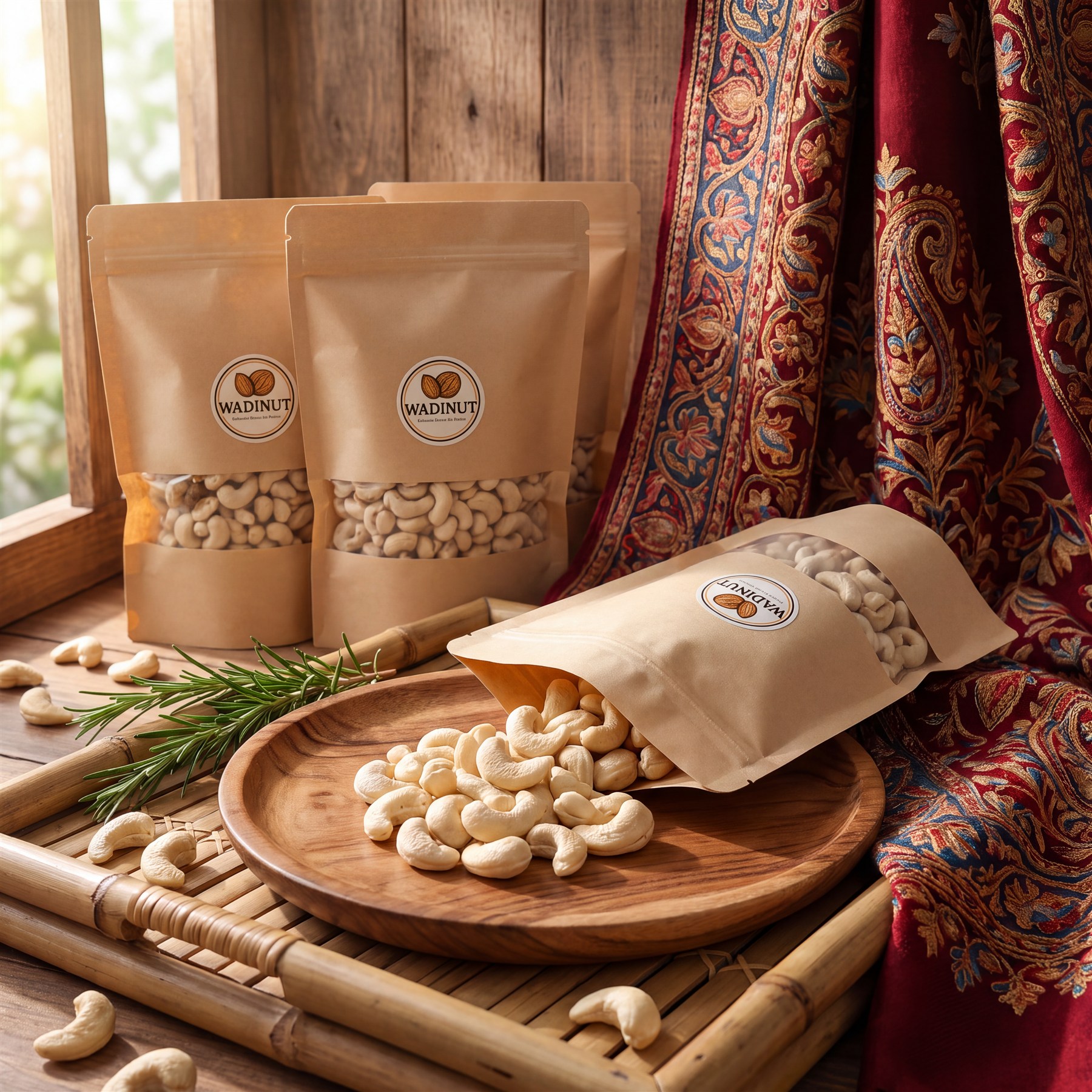
Vacuum-sealed. Cashews can absorb moisture and surrounding odours during storage. Vacuum-sealed packaging reduces their exposure to air and helps maintain freshness.
Reviews
There are no reviews yet.